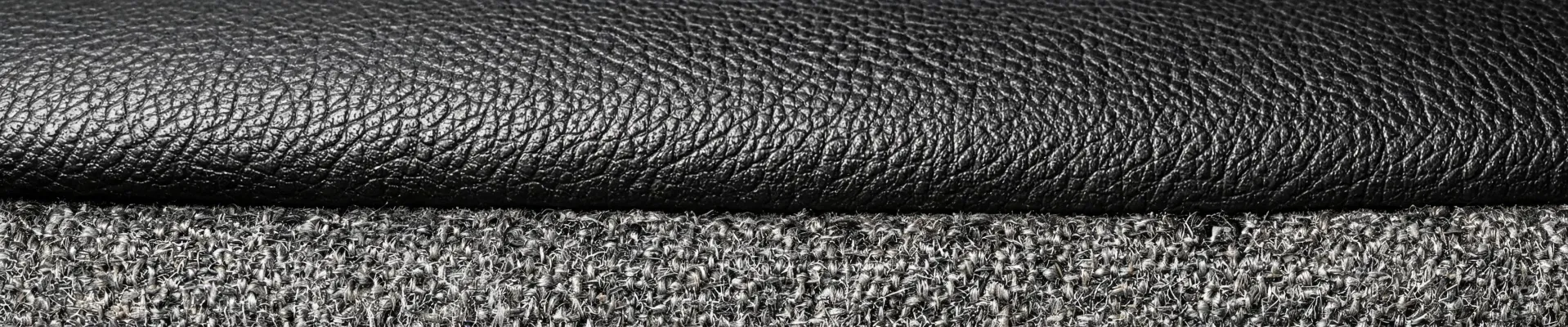
If you're ordering synthetic leather in bulk—whether you're a sofa leather distributor, an OEM, or a furniture manufacturer—stop comparing price per yard and start comparing cost per installed unit.
That's the short version. I manage the upholstery materials budget for a mid-size furniture company, about $1.4M a year in materials, and I've been tracking every roll, every rework ticket, and every warranty claim for six years. In 2024, we moved a big chunk of our residential sofa line from bulk PVC leather to Ultrafabrics' Ultraleather and Brisa. Our raw material cost per yard went up. Our total spend on that line went down about 12%. That gap is the reason I'm writing this.
Why I used to think cheap PVC was the answer
When I first started in this role, I assumed basic faux leather is basic faux leather. The only question was price. Honestly, I didn't understand why anyone would pay a big premium for something that looked similar to a cheap PVC. Then came the production run I now call 'the great delamination.'
We built a batch of 400 sofas with a bulk PVC leather that passed our initial checks. After a few weeks in the warehouse, the material started separating from the foam along the arm creases. We reupholstered 47 units. That was about $8,600 in labor and materials, plus a late delivery penalty. The 'cheap' option became the expensive option, and not in a subtle way.
Since then, I've built a cost tracking spreadsheet that treats every material as a system, not a line item. The advice 'always get three quotes' is fine as a starting point, but it ignores what happens after the roll hits the cutting table. That's where most of the hidden cost lives. This is basically the synthetic leather distributor buying guide I wish someone had handed me in 2022.
What I actually compare when buying synthetic leather in bulk
Here are the specs I actually put into our total cost of ownership (TCO) model. By TCO I mean the full cost of getting an acceptable product out the door, not just the invoice for the roll.
1. Yield and cutting waste
Material price is easy to compare. The harder part is yield: how many usable sofa panels you get from a roll. In our 2024 audit, the Ultraleather and Brisa rolls averaged about 1.1% cutting waste. The PVC rolls we were using averaged 3.4%. That doesn't sound dramatic, but on a 12,000-yard order, it's several hundred yards going into the scrap bin. A lot of that waste came from edge shading, loose backing, and small surface flaws. The middle of the roll was fine; the edges were the problem.
2. Flex and abrasion performance
For residential sofas, the material has to flex around arms and seat cushions without cracking or delaminating. We run a simple flex fold test, 20,000 cycles under load, plus an abrasion check. Ultraleather and Brisa passed our test; the bulk PVC we tested did not. I'm not saying all PVC is bad—I'm saying that specific PVC was not built for that kind of movement. If your customers have kids and pets, cleanability and abrasion matter more than the initial quote.
3. Distributor support and color consistency
One of the reasons we switched to Ultrafabrics through a dedicated distributor was color consistency. In 2023, a PVC shipment had a clear shading mismatch between roll 14 and roll 32. The distributor argued for three weeks before issuing a credit. With the Ultrafabrics line, our distributor sends lot matching reports and keeps the same color codes across production runs. That matters more than it sounds. If you're a sofa leather distributor, you don't want one batch showing up gray-purple and the next purple-gray. Your customers will blame you, not the material.
4. Portfolio and private label
Ultrafabrics is not one material. The portfolio includes Ultraleather, Brisa, Promessa, Volar Bio, and Tottori suede. As a distributor, OEM, or wholesale buyer, that means you can offer different performance and price tiers without juggling five suppliers. They also support OEM/private label programs, so you can put your own brand on a proven material if the volume makes sense.
Where bulk PVC leather still makes sense
I don't want this to sound like a 'PVC is evil' post. It isn't. We still buy bulk PVC leather for a few commercial projects where the product is flat, simple, and expected to last three years or less. In those cases, the lower unit price is real savings. If you're making office chairs, budget hotel headboards, or other low-flex applications, PVC can be the rational choice. The problem isn't the material category; it's using the wrong material for the job and pretending the only difference is the label.
The synthetic leather industry has changed, too. When I started buying, 'vegan leather' basically meant PVC. As of early 2026, we're seeing bio-based options like Volar Bio and solvent-free constructions that test as well as materials from five years ago. What was best practice in 2020—pick the cheapest roll and hope for the best—doesn't hold up when materials are engineered with documented performance data. The fundamentals of good procurement (test, measure, document, compare TCO) haven't changed. The execution has.
So if you're about to place a large order, here's the honest advice: ask for technical data, request a trial roll, run your own flex and abrasion test, and calculate cost per acceptable unit rather than cost per yard. And if a supplier tells you every material in this category is the same, that's a reason to keep looking. The low price is not the problem. The unexamined purchase is.

Lucia Bianchi is a woven apparel-fabric analyst covering cotton, linen, wool, rayon, denim, shirting, twill, satin, poplin, and blended garment fabrics. She applies the ISO 1833 series for fibre composition and ISO 105-C06 for laundering colourfastness while checking GSM, yarn count, usable width, shrinkage, skew, shade grade, drape, and surface defects. Her specification guides help designers, sourcing teams, and mills align fibre claims, lab dips, bulk tolerances, care conditions, and garment performance before production approval.