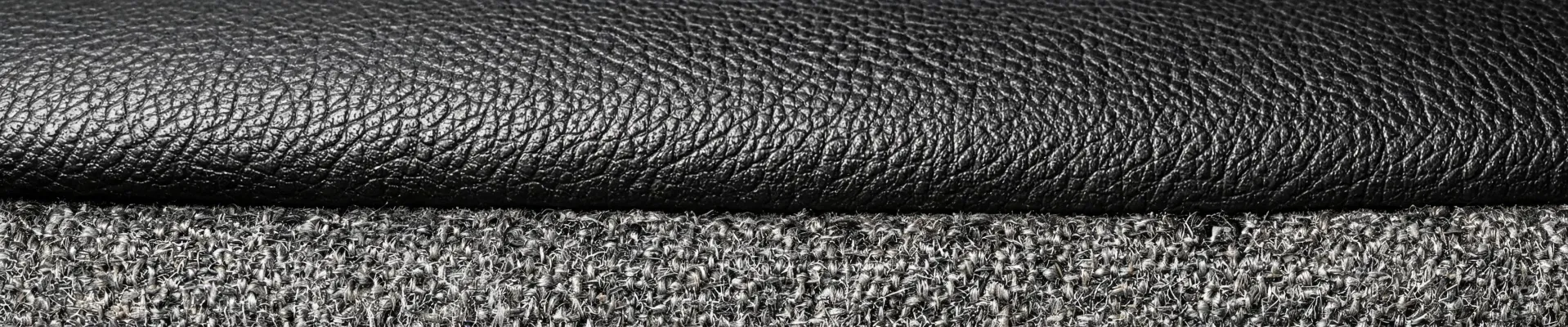
It started with a quote that looked too good to pass up. If I remember correctly, it was September 2024, and our operations manager asked me to source 5,000 yards of black faux leather for a new seating line we were pitching to an automotive leather OEM customer. Our incumbent supplier quoted $6.20 per yard. A new vendor—some microfiber leather manufacturer we'd found through a distributor—came in at $4.10. That's a 34% price gap, which on a $31,000 order looked like a $10,500 win.
I placed the order without visiting the factory or running our full panel of tests. That was my first mistake. As the person who manages over $2M in annual purchasing for a 200-person contract furniture company, I know better. But the savings number was right there, and my finance team liked seeing a lower unit cost on the P&L. What I didn't factor in was everything that would happen after the PO was signed.
When the first batch arrived, the material smelled like a chemical plant. Not just "new car" smell—a sharp, solvent-heavy odor that lingered in our warehouse. We let it air out for a few days and tried cutting it anyway. The coating had pinprick bubbles, and a few rolls delaminated as the cutter handled them. We ran our standard rub test on a sample, and it failed at around 11,800 cycles. Our minimum for that automotive program was 30,000. Actually, let me be precise: the test method was Taber abrasion per our customer's spec, and the lab flagged visible wear at 11,800 cycles. Either way, it wasn't close.
We had to call the customer and delay the pilot run. That triggered a chain of costs: a $4,200 expedite fee at a local converter to get replacement material from another supplier, overtime for a weekend shift, and a non-refundable original order because the vendor claimed we'd approved the samples. I added it up after the dust settled—shipment rejection, warehousing time, duplicate labor, expedite fees, customer credits. About $12,000 in additional spend, not including the goodwill we lost with the customer. The $10,500 savings turned into a net loss of $1,500 before we even counted the stress.
Why did this happen? I was evaluating the sticker price, not the supplier. Cheap vendors can look great on paper because the unit cost is the only thing you see at first. But the actual cost of a fabric order includes lead-time reliability, quality consistency, compliance documentation, and a long list of things that don't show up on an invoice. That's when I started researching how to evaluate solvent-free leather manufacturers properly. Partly because the failed batch was solvent-based, and partly because one of our automotive customers had started asking about our environmental footprint.
What most people don't realize is that "solvent-free" is more than a marketing label. It refers to the manufacturing process of the polyurethane coating. In solvent-free or low-solvent processes, the coating formulations don't rely on DMFa and other volatile chemicals that are problematic in both worker safety and end-use off-gassing. But the nuance is that "solvent-free" doesn't automatically mean durable or sustainable. You still have to verify testing, certifications, and actual performance claims. The term tells you what was not used, not what the material can withstand.
I'd like to say I had a clear framework from the start. I didn't. I talked to our lab manager, our quality engineer, and two other procurement contacts. We eventually developed a checklist that I still use today: unit price is one line item, but I also look at consistency across lots, certifications like REACH and OEKO-TEX, performance data for abrasion and hydrolysis, supply chain transparency, and technical support. That last one turned out to be critical. Can the manufacturer answer questions about care codes, seam slippage, and edge treatments? Can they provide a reference list of other furniture OEMs who've actually qualified their materials?
When I finally contacted Ultrafabrics—I had seen their name on automotive spec sheets for years—I didn't expect a textile company to have engineering support. I was wrong. They sent a regional rep with sample swatches, datasheets, and a reference list that included at least two furniture manufacturers we knew. Their prices were higher than the cheap vendor, but the total cost of ownership made sense. We ended up qualifying two of their materials for the program: Ultraleather for the seat and back covers, and a suede fabric from their range for a secondary trim area. Finding a reliable suede fabric supplier was actually harder than the leather side, because the hand feel is so subjective. But Ultrafabrics provided a physical sample bank and testing data for both materials, which shortened our validation from four weeks to two. The automotive leather OEM customer approved the new materials, and we got the pilot running in time for the trade show.
Now, I should add a caveat. This approach worked for us because we're a mid-sized contract manufacturer with predictable order patterns and a customer base that prioritizes compliance. If you're buying small quantities for decorative pillows, a cheaper PVC/PU roll might be perfectly acceptable. If you're sourcing for a program where failure means a recall, the calculus is completely different. The key is matching the supplier's capability to your actual requirements—not just comparing price lists.
Here's something vendors won't tell you: the first quote is almost never the final cost. There are sampling fees, freight minimums, quantity tolerances, and rejection policies. But the bigger hidden cost is the risk of non-performance. A $2-per-yard saving on a 5,000-yard order is $10,000—until you spend $12,000 to fix the damage that material causes. That's the total cost of ownership idea in a nutshell.
How do I evaluate suppliers now? I calculate TCO before comparing quotes. Unit price plus freight plus testing costs plus expected yield loss plus returns and claims risk plus internal handling time plus line-down costs. I also verify certifications through official channels, not just brochures, and I order a pilot batch before committing to production quantities. Would I go back to the cheap vendor? No. But not because they're a "bad" company—they might be fine for a different application. The mismatch was between their capabilities and our requirements.
That's actually the lesson I want to share. Don't ask "which supplier is cheapest?" Ask "which supplier is cheapest for this program when you count every cost?" In our case, the answer was Ultrafabrics—their Ultraleather and Brisa lines, and later their suede fabric. But the framework is what saved us, not the brand. The $12,000 lesson was worth learning, but you don't have to pay tuition to learn it.

Lucia Bianchi is a woven apparel-fabric analyst covering cotton, linen, wool, rayon, denim, shirting, twill, satin, poplin, and blended garment fabrics. She applies the ISO 1833 series for fibre composition and ISO 105-C06 for laundering colourfastness while checking GSM, yarn count, usable width, shrinkage, skew, shade grade, drape, and surface defects. Her specification guides help designers, sourcing teams, and mills align fibre claims, lab dips, bulk tolerances, care conditions, and garment performance before production approval.